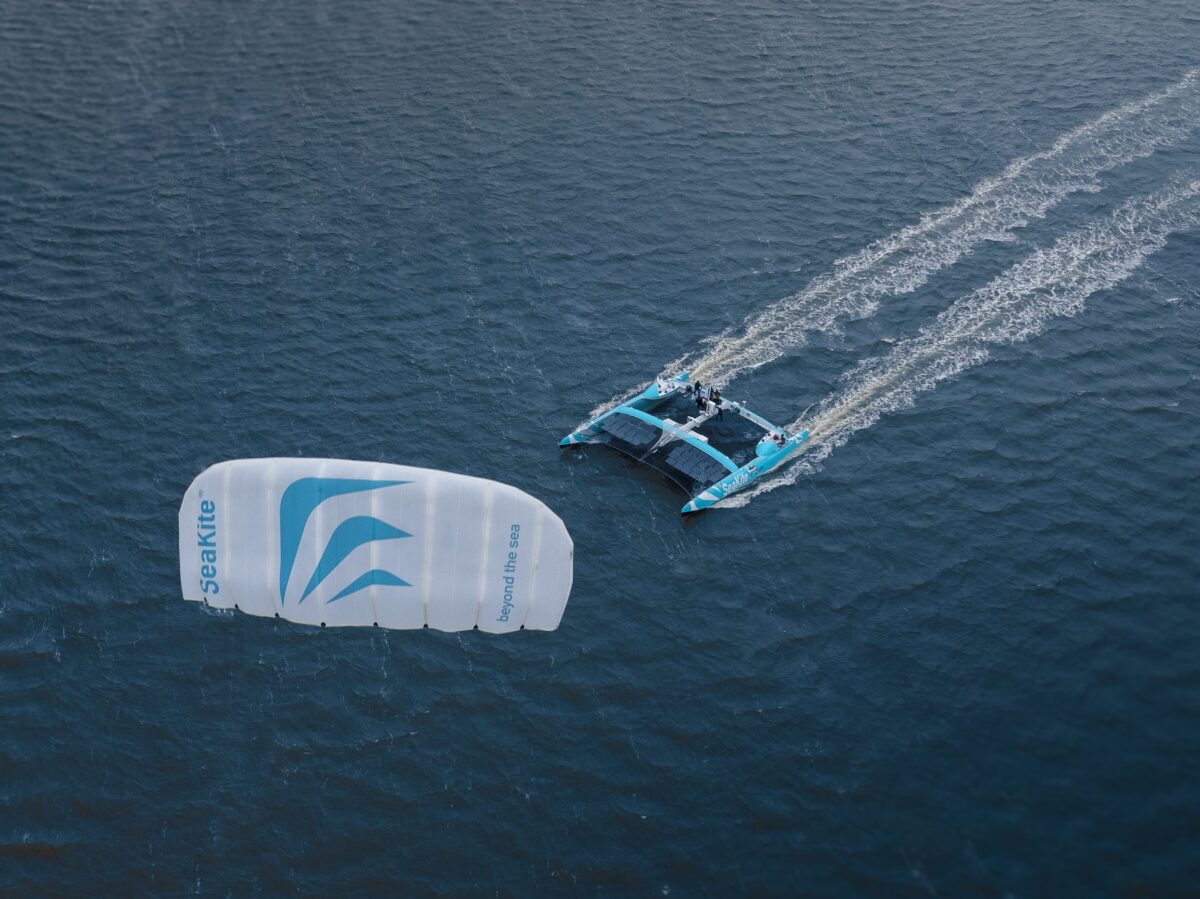


Based in Gironde, Beyond the Sea specializes in the design and manufacturing of giant kites engineered to tow vessels of all sizes.
1. Have you already carried out tests on sailboats, combining a kite with a conventional rig to increase speed?
Yes, we have already conducted real-world tests combining a kite with a conventional rig, but it is still a product under development. Starting this autumn, in partnership with the Mechanics Laboratory at the University of Montpellier, we will conduct comparative performance tests using conventional rigs alone, combined kite and rig configurations, and the kite alone.
2. Will there be sea trials?
Yes, this will be a scientific campaign conducted in the Mediterranean, off La Grande-Motte. We will collect real-world performance data on a well-known boat type, a Pogo 2.
Before testing begins, we will organize a training phase for the crew—all professional sailors with offshore racing and recreational sailing backgrounds. We will train them on operating techniques that differ from traditional sailing. After that, we can push the sailing envelope to its full potential.
At Beyond the Sea, we have developed a solution that is exceptionally efficient on downwind points of sail, but slightly less effective upwind, whereas conventional sails deliver higher performance when sailing close to the wind. The two systems are therefore complementary.
3. Are you the only ones exploring this "sail plus kite" combination?
Other companies have conducted similar research, such as Syroco in Marseille.
4. Do you also plan to test kites on large vessels, such as sail-powered cargo ships?
Regarding maritime freight decarbonization, we believe deploying the SEA KITE (an automated giant kite system) on cargo ships alongside other wind-propulsion solutions is technically viable. However, we have not yet conducted full-scale sea trials on such vessels—only computer simulations and feasibility studies so far.
To my knowledge, there have been no sea trials of towing kites on existing large sailing cargo ships. It has been examined by various design bureaus and proposed to several shipowners, but I do not believe any trials are currently being prepared.
5. Do your kite tests on recreational sailboats also provide value for sailing cargo vessels?
Testing on recreational sailboats allows us to obtain operational feedback very quickly, whereas running tests directly on cargo ships would be long, capital-intensive, and time-consuming.
This does not stop us from testing large-scale kites that can subsequently be deployed on large merchant vessels. On the Mini 6.50, we will use an 80 sqm kite, and next year, we will conduct sea trials on an IMOCA monohull with a 500 sqm kite.
We will demonstrate that this is a viable and profitable solution, and that the "rig plus kite" combination delivers genuine performance gains over a standalone rig. That said, will this hold true for commercial cargo operations? That remains to be seen, because operational constraints are substantial—notably around automation. On a cargo ship, the crew needs systems that are as straightforward and push-button as possible.
Therefore, with both systems operating together under fully automated control, will the actual performance gains achieved be decisive in their operational choices? We firmly believe so, but ultimately shipowners make the call. It is up to us to convince them.
Interview conducted and edited by Yves Eudes
Follow project updates?
Contact us for preliminary shipping inquiries or to review your freight flows.
Contact us